01
SPOS & unified operations
Run counter sales, wholesale orders, returns, stores, warehouses, delivery, people and finance from role-based App and Web workspaces.
Run SPOS, B2B restaurant supply, grocery retail, catalogues, multi-warehouse stock, payments, delivery, loyalty, campaigns, people, finance and compliance from one FoodsGrid App and Web workspace.
 Supplier & Grocery OS
One connected core
Supplier & Grocery OS
One connected core
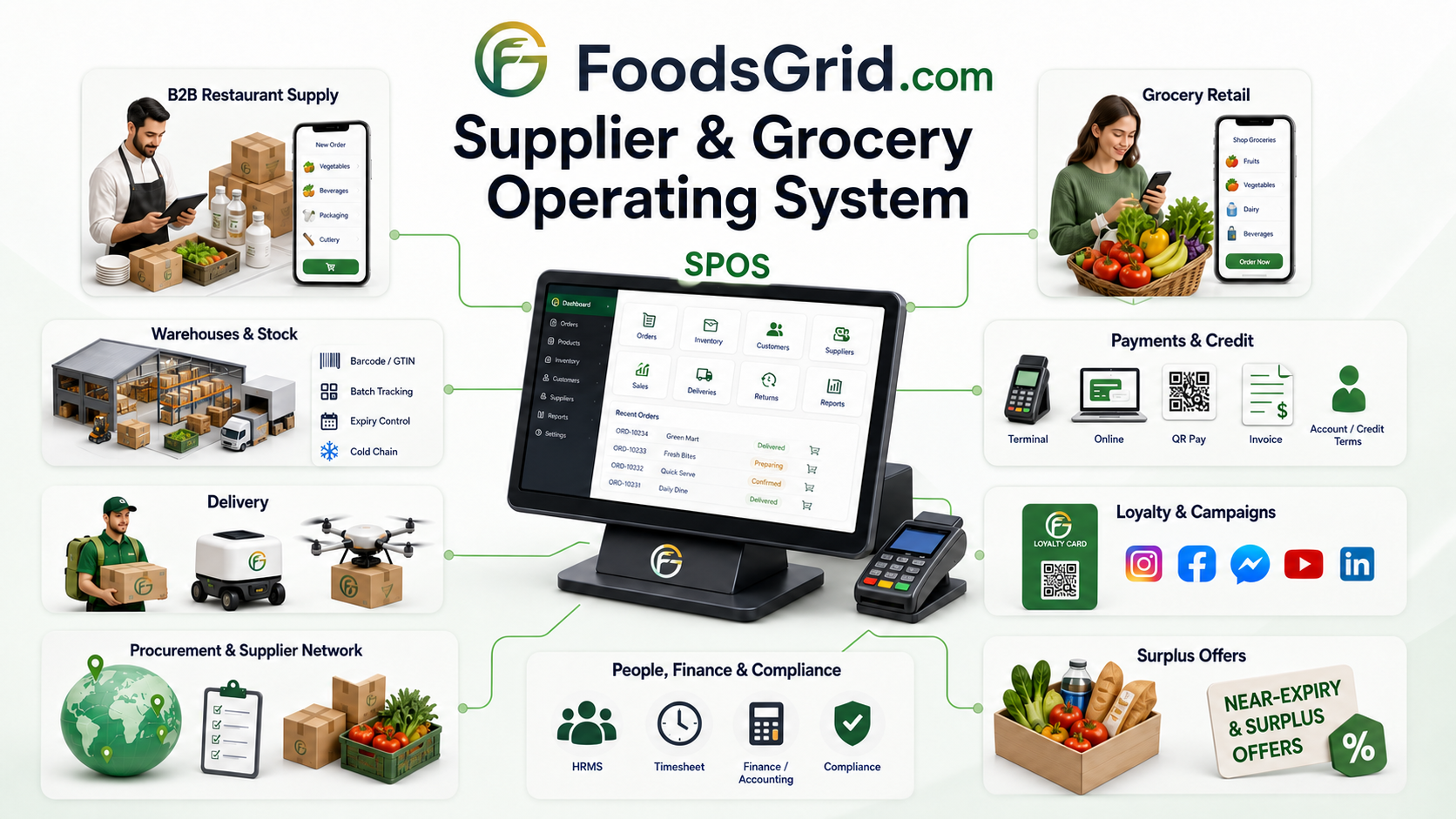
FoodsGrid is designed as the operating layer linking product data, wholesale relationships, retail demand, fulfilment, compliance and performance.
Run counter sales, wholesale orders, returns, stores, warehouses, delivery, people and finance from role-based App and Web workspaces.
Sell ingredients, beverages, packaging, cutlery and regular operating supplies using buyer-specific catalogues, prices, terms and approvals.
Serve shoppers through store SPOS, FoodsGrid marketplace, your own website or microsite, App, delivery and pickup.
Control GTIN product data, locations, lots, expiry, FEFO, purchase orders, transfers, receiving and replenishment.
Connect terminals, online checkout, QR, mobile wallets, cash, invoices, account credit, settlements and accounting reconciliation.
Coordinate scheduled B2B drops and grocery delivery or pickup through your fleet or connected human, robotic and drone partners.
Create merchant-branded loyalty cards, tiers, points and referrals connected with SPOS and checkout, plus coordinated campaigns.
Keep cold-chain readings, batch genealogy, recall actions, certificates, cleaning and audit evidence visible across locations.
Connect HRMS, timesheets, landed cost, margin, invoices, accounting and predictive demand with outlet and warehouse performance.
Catalogue, customer terms, order, payment, inventory, fulfilment and finance stay connected across wholesale and retail.
Owners, account managers, buyers, cashiers, warehouse teams, drivers and accountants access the tools relevant to their roles—without losing the connected business view.
The FoodsGrid Omnichannel Bot and Unified Campaign Management tool coordinate product offers, account communication and shopper journeys across the channels each audience uses.
FoodsGrid supports shopper loyalty and B2B trade accounts while linking multiple payment methods to orders, invoices and accounting trails.
Choose branded card templates, define custom levels, points, purchase and referral rewards, bonus rules, redemption policies and consent-led programme terms.
Your Grocery RewardsGOLD MEMBERLoyalty points are not currency. They are redeemable only according to the merchant’s published programme policy and enabled checkout rules.
Use a connected payment layer across SPOS, online and account orders, with order-linked invoices, settlements, credit control and reconciliation.
Available payment and credit methods depend on country, selected acquirer or payment provider, terminal certification, merchant policy and commercial agreement.
FoodsGrid connects catalogue data, purchasing, landed cost, inventory and customer-specific pricing so suppliers and grocers can sell consistently without losing local control.
Select available products, quantity, reduced price and fulfilment window; publish to suitable trade buyers or shoppers; accept checkout; and track what was sold instead of discarded. Food-safety information, traceability and local rules remain the merchant’s responsibility.
Digital workflows and connected sensors can carry evidence from receiving through storage and fulfilment, helping teams respond quickly to temperature deviations, expiry risk or recall events.
FoodsGrid is designed to connect store and warehouse fulfilment with customer promises, pickup slots, route planning, delivery partners and settlements.
Delivery modes and geographic availability depend on local partners, regulation, technical integration and agreed service areas.
A unified data layer can connect B2B and retail sales, landed cost, stock, expiry, customer engagement, staffing and fulfilment.
A supplier or grocery business can begin with its catalogue and SPOS, then add wholesale commerce, fulfilment, engagement, finance and connected compliance.
Business profile, product master, website or microsite, FoodsGrid App/Web presence and initial price lists.
SPOS, B2B ordering, grocery ecommerce, payments, loyalty, pickup and delivery.
Purchasing, inventory, batch and expiry, warehouse flows, HRMS, timesheets and finance.
Campaigns, bot, CRM, landed-cost visibility, compliance monitoring and predictive insights.
No. SPOS is an important operational component, but FoodsGrid is being developed as a broader Supplier & Grocery Operating System connecting B2B and B2C commerce, products, stock, payments, credit, delivery, loyalty, campaigns, people, finance and compliance.
Yes. The proposed model supports organisation-level catalogues and controls with location-level stock, pricing, users, orders and fulfilment visibility.
Restaurant buyers may use negotiated catalogues, pack sizes, recurring orders, approvals, credit limits and invoice terms. Shoppers typically use retail prices, promotions, loyalty, immediate checkout, pickup or delivery. Both can use the same trusted product and inventory layer.
The platform is designed for lot and expiry capture, FEFO workflows, supported sensor integrations and traceable fulfilment. Exact capabilities depend on the product category, local rules, devices and source data.
FoodsGrid is intended to support ecosystem integrations. Availability depends on local provider APIs, certification, commercial agreement and implementation scope.
Begin with your catalogue, SPOS, B2B ordering or grocery ecommerce—and expand into payments, fulfilment, loyalty, compliance and predictive operations.